 This past December, it became feasible for any skilled hacker to scale up a hacking agent, spending hundreds in token cost to find thousands in bounties. I call this the “Bug Bounty Singularity”. This is the story of JD (xssdoctor) and I building a hackbot which found 126 bugs in the last 5 months.
If you want to just read about the bugs, you can jump straight to the bugs.
Table of Contents
The Story (written by JD)
The discord message came in at 6:10am:
rez0: Want to build a hackbot?
It wasn’t unusual for rez0 to message me at 6am. These days, we were talking to each other a lot throughout the day. It was a good fit. I liked to go deep into a target, pouring over the javascript and learning the mechanics of the app. Alternatively, rez0 tended “go wide”, finding niche or overlooked attack surfaces that most people would scroll right past, chaining together weird behaviors and forgotten endpoints. What brought us together was our love of AI.
Our conversations mostly revolved around Claude Code skills that we had written, or bugs that we had found using our agents. I generally pointed my agents at minified javascript. My skills were based on source-to-sink analysis, client side paths and feature flags. Rez0 created incredible skills for fuzzing, subdomain enumeration, and idor testing.
Claude 4.6 changed everything. Until then, the agents were being used to accelerate our workflow. But suddenly, they were finding bugs independently. We would point the agent at a target, load our skills and real bugs would pop out . The question was no longer whether the agents could help us hack. The question was whether they could replace entire parts of our workflow and how cost effective would it be.
The most important decision that we make as bug bounty hunters is how to spend our time. Do we “go deep” and spend hours or days understanding the mechanics of the application or should we “go wide”, spending weeks or months coding and maintaining an automation framework? Every minute spent on recon is a minute not spent hacking.
But unlike humans, AI agents don’t get tired or bored. AI agents don’t have to sleep or eat. They don’t procrastinate by watching 5 hours of minecraft videos on youtube (editor Joseph here: stop calling me out JD). Rez0’s idea was simple: make an automation framework which continually does wide scope recon and then goes deep into every target.
The discord message came in at 6:11am:
Xssdoctor: Lets build a freaking hackbot!
The Prototype
Day 1: 9:11am
xssdoctor: This is going to be easy
It was not easy.
At first, the idea sounded almost trivial. We had each spent the past year building Claude Code skills and finding great bugs. rez0’s skills focused on server-side bugs and wide-scope recon. Mine were designed for deep application analysis and client side vulnerabilities.
Individually, the skills were already useful. We used them to accelerate our own workflows. The plan was to merge them into a single autonomous system: a hackbot capable of performing broad recon and deep analysis at the same time.
The architecture seemed straightforward enough. The bot would live in the cloud. We would feed it a list of bug bounty targets, and it would continuously work through them one-by-one, loading different skills depending on what it found. Recon skills would map the attack surface. Analysis skills would inspect the application logic. Additional agents could validate findings, chain bugs together and write reports automatically.
Of course, since we were incapable of doing anything halfway, we immediately started thinking about dashboards, beautiful dashboards, Claude-generated dashboards. Dashboards which looked like this.
 The dashboard, in all its Claude-generated glory.
Within three hours, we had prompted into existence queues, telemetry, logs, bug tracking, severity scoring and agent orchestration. We were up and running.
Eight hours later, reality hit
Hackbot rule # 1
We woke up to a dashboard full of bug reports and a quarter of our tokens gone. For a few seconds, it felt like success. Then we started reading the reports.
The first bug was a self-xss. The second was a CORS misconfiguration that wasn’t exploitable. Then came a “critical RCE” that turned out to be complete nonsense. One after another, the findings collapsed under even minimal scrutiny. The dashboard looked impressive, but underneath it was mostly noise.
At first we were confused. These were the same skills we used on our own machines. Individually, they had already helped us find real bugs. Why did they suddenly become useless the moment we connected them to a cloud orchestration system? The answer was obvious once we watched the bot work in real time.
When we hacked manually, we were constantly steering the agent. We would notice when it got distracted by a low-signal endpoint. We would redirect it toward a more interesting code path. We would tell it to retry a request, inspect a response more carefully, or pivot into a completely different attack surface. Even when the AI was “autonomous”, we were still acting as a feedback loop. The hackbot had none of that. That’s when we made the first hackbot rule:
Hackbot rule number 1: Always keep logs
We needed visibility into the agent’s reasoning process. Not just the final reports, but every command it ran, every request it sent and every conclusion it reached.
Our solution was simple: stream the entire claude session directly into discord
Now, we could watch the bot think in real time, and the logs became more valuable than the findings themselves. The difference between a useful hacking agent and an expensive hallucination machine turned out to be observability
Keep Hacking!
The first thing we realized was that the bot barely hacked at all.
We had written an extensive claude.md file explaining exactly how the bot should behave, what attack surfaces to prioritize and how to use our skills. In theory, it had everything it needed. In practice, it would burn through a target in twenty minutes and declare victory.
The behavior looked convincing at first. The bot would enumerate endpoints, run recon, test a few payloads and generate a polished report. But once we started reading logs, it become obvious what was happening. It was stopping at the first plausible explanation for everything. If the request failed, it moved on. If an endpoint looked boring, it ignored it. If a bug almost worked, it rarely retried from another angle. Humans don’t hack like that. When we work manually, we spend hours obsessing over tiny details. We retry requests with different headers. We follow weird redirects. We stare at minified javascript until some buried feature flag suddenly makes sense. Most real bugs only appear because a human decides not to give up after the first dead end. This became Hackbot Rule # 2
Hackbot rule number 2: Keep the bot hacking
The solution was not to make the model smarter, but to make it more persistent. There are many ways to extend agent runtimes, but we settled on a technique borrowed from long-running AI coding workflows: Ralph loops.
A ralph loop is deceptively simple. The agent performs a task, evaluates the result, generates new follow-up tasks and then repeats the cycle indefinitely until a stopping condition is reached. Instead of treating hacking like a single prompt-response interaction. The bot treats every finding as the beginning of another investigation.
This changed everything. Instead of spending twenty minutes on a target, the bot would spend hours digging deeper into anything even remotely suspicious. A weak signal was no longer ignored. It became a branch in the investigation tree. A reflected parameter became a search for hidden sinks. A strange redirect became a hunt for auth bypasses.
Most importantly, the bot started revisiting its own conclusions. One agent would decide an issue was not exploitable. Three loops later, another agent would come back with a completely different perspective and prove that it was. The longer the loops ran, the more the system began to resemble an actual hacker mindset. Finally, the hackbot was becoming a hacker.
But after a while, we started to see the other side of persistence. A ralph loop doesn’t know when to quit. On a rich target, hacking for hours was exactly what we wanted. On a thin target with almost no attack surface, that same persistence was a disaster. The bot would spend hours, and a pile of tokens, hunting for a bug that was never there.
So we moved away from pure ralph loops and put another bot between us and the worker: an orchestrator. Its job was to watch the worker hack and judge the target. If the attack surface looked weak, it cut the worker loose and moved on to the next target. If the attack surface looked good, it told the worker to keep hacking — and it would actively encourage it, with things like “there is definitely a bug here. find it!”
That one change fixed both failure modes at once. The bot stopped giving up early on good targets, and it stopped wasting tokens on bad ones. There was only one more problem that we needed to solve…
Validation
There is an almost endless steam of content related to the “death of bug bounty”. Most of it points to the same problem: AI slop.
After a few weeks running the hackbot continuously, we experienced what everyone else would soon experience:

The bot was finding interesting behavior. It was uncovering strange responses, unusual edge cases and occasionally even genuinely dangerous vulnerabilites. But it was also hallucinating constantly. A reflected parameter would become a fake XSS. A verbose error message would be an imaginary RCE. A harmless CORS configuration would somehow transform into “critical account takeover”.
At one point. The dashboard looked incredible. Thousands of findings. Security scoring. Auto-generated reports. But most of it wasn’t real.
When we started measuring the output honestly, the numbers were brutal. Roughly 80% of the findings were false-positives.
That sounds catastrophic, but the strange thing was that the remaining 20% were real. The problem was not that the bot couldn’t hack, but that it had no skepticism. Humans naturally validate their own ideas while hacking. We retry requests. We test assumptoms from multiple angles. We ask ourselves whether something is actually exploitable or whether we just want it to be exploitable. Left alone, the agent did none of that. Once it convinced itself a bug existed, it would happily generate a beautiful report explaining why.
Thats when rez0 had an idea. It was actually such a great idea, we made a rule about it
Hackbot rule number 3: Validate
We decided to make a validation bot. This bot had a singular purpose: aggressively disprove findings generated by the hacking agents. Instead of rewarding the model for finding vulnerabilities, we rewarded it for killing them.
If the hackbot claimed XSS, the validator attempted to break the exploit chain. If the bot reported SSRF, the validator looked for evidence the request never actually left the network boundary.
Most importantly, the validator had no emotional attachment to the original finding. It did not want to “please us” by finding a bug.
Our false positive rate dropped from 80% to about 60%.
Every meaningful finding needs an adversary. One bot hacked. Another bot validated. The more paranoid the system became, the more useful it became.
Stay Logged In
When we started, our hackbots were “going wide” but mostly finding duplicates and informationals. We knew what the problems was. We weren’t authenticated. Any bug bounty hunter knows that the real money is post-auth.
The problem sounds trivial: just give the bot a session. In practice, almost nothing cooperates. Very few targets hand you a non-expiring cookie or auth token. The good ones rotate sessions aggressively, so a token you captured in the morning was worthless by lunch. And a bunch of programs actively fight anything that even smells like a bot logging in. Amazon in particular spends an enormous amount of engineering effort making sure automated logins simply do not happen.
The hardest part was that our bot lived on headless cloud boxes. And headless Chrome is exactly what every one of these anti-bot systems is tuned to detect and filter. The login page would load, the bot would type the right credentials, and the site would quietly decide it was a robot and drop a CAPTCHA or a “verify it’s you” wall in front of it. There are services like Browserbase that promise to beat the CAPTCHAs and pass as a real browser. We tried but could never get them to reliably work for us.
Then we looked at our metrics, and it was worse than we thought. At one point, 80% of our tokens were being spent on auth. Not hacking. Not validating findings. Just trying, over and over, to log the bot into targets that did not want it logged in. We were burning the entire budget banging on front doors that slammed shut every time.
The fix, when we finally landed on it, was almost embarrassingly low-tech. Stop fighting the anti-bot systems on their terms. So we took one physical computer, a real machine with a real browser, and we built an agent that lived on it whose only job was to log in like a human — real Chrome, real profile, real fingerprint — and keep those sessions alive. When a token was about to expire, it quietly refreshed it. The cloud hackbot no longer touched login pages at all. It just asked the login agent for a live session and got to work.
The anti-bot systems were looking for headless Chrome on a datacenter IP. What they got was an ordinary browser on an ordinary computer, doing exactly what an ordinary user does. It turns out the winning move against a bot-detector is to not look like a bot.
Hackbot rule number 4: Let a real browser do the logging in
Once the bot could stay authenticated, the criticals started pouring in. Look at the bug list below — the IDORs, the broken access control, the write-primitives on other users’ objects. Almost none of that is reachable logged out. The single biggest jump in the quality of our findings did not come from a smarter model or a better skill. It came from the boring, stubborn work of keeping the bot logged in.
Real Talk
Clearly this wasn’t a breezy walk in the park, and we still have plenty of false positives. That said, we are two guys. And I’m a cardiologist full time. Since we began, it has gotten easier as well. Both codex and claude code added /goal mode, and opensource hacking agent systems (like strix) have been released over the last 6 months.
If we can do this, we believe that it massively increases the number of people who can use coding agents + harnesses to find critical vulnerabilities. And as you’ll see when you read the Google Platform takeover and the Western Union vulnerability below, there is tremendous real impact that can be had with these types of vulnerabilities.
THE BUGZ
An Overview of the Findings
Across the first half of 2026, the hackbot’s findings added up to 126 vulnerabilities — spanning HackerOne programs, Google’s VRP, and direct disclosures (everything from the writeups below plus the 64 reports rez0 and I filed together on HackerOne). Bug bounty hunters love data, so here’s all of it, ugly stuff included.
Severity
Critical  █████████████████████████  49
High      ████████████████████       39
Medium    ████████████████           31
Low       ██                          3
Unrated   ██                          4
88 of 126 findings (70%) were rated High or Critical.
How they landed
| Outcome |
Count |
| Accepted / resolved / triaged / in review |
77 |
| Duplicate |
35 |
| Informative / Not Applicable |
14 |
Here’s the stat we’re proudest of: 112 of 126 (89%) were confirmed real — either accepted by the program or closed as a duplicate. And a duplicate is not a miss. It means the bug was genuine and exploitable; someone just got there first. Only 14 were waved off as informative or N/A. For a system that two guys point at a target and walk away from, an 89% true-positive rate is amazing.
Our single largest bounty was $15,000 (a one-click account takeover). We still have one unpaid that could dwarf it though ;)
And a chunk of the High/Critical findings are still sitting in triage, waiting on the programs to pay.
Vulnerability Research Portfolio
This is the coolest (and one of the most impactful) bugs I’ve ever found. And by “I”, I mean claude code, xssdoctor, and I. 😂
The full chain is actually really cool:
- At some point in the past during all my Google api research (which you’ll see below), this Google API key was slurped up into my Google API key database:
AIzaSyB…
- We tested it against the Identity Toolkit
getProjectConfig endpoint, which leaked the Firebase project partner-dri-prod and its authorized domains — including partnerdri.com, partner-companion.cloud.google, and delivery-readiness-portal.cloud.google
- Visiting
partnerdri.com revealed the Delivery Readiness Portal, an internal Google partner management system
- The Firebase project allowed email+password signup without email verification, so we registered an account.
- An unauthenticated API endpoint (
GET /partner) leaked all 2,870 partner organizations and their 3,886 email domains (already reported in report 495884998)
- Of those 3,886 domains, ~170 had expired DNS registrations and were available for purchase
- We registered one of these expired domains, created a Firebase account with that domain email, and signed up on the DRI portal
- When we logged in with google as that new admin, we had partner admin access
- Once in there, as a normal user, we could see the DRI admin for that partner organization was so we set up a google workspace with that email.
- We made another partner admin to do testing
- Claude code was testing and figured out that one of the admins could POST /dri/api/v1/user with “role”: “Google Super Admin” on the OTHER admin to escalate to a google super admin.
- Login with that second admin you can now see EVERY user (like 60,000 and every org and manage/delete/approve/create)
Critical — Western Union API Leaks all Customers’ Data
Yesterday, we discovered a critical vulnerability in Western Union’s customer profile API. The endpoint at https://www.westernunion.com/cusprofile/v2/cust/customers/multiparam allows anyone to look up customer records by phone number with zero authentication.
A simple POST request with a phone number returns full customer PII including full name, email address, phone numbers, WU account number, and in some cases date of birth, home addresses, and government-issued document numbers. A single query can return multiple customer records.
Example request (no auth needed):
curl -sk \
  -H "Content-Type: application/json" \
  -H "x-wu-correlationId: test-001" \
  -H "x-wu-externalRefId: test-001" \
  -X POST "https://www.westernunion.com/cusprofile/v2/cust/customers/multiparam" \
  -d '{"customer":{"phoneNumber":[{"countryCode":"1","number":"6068752453"}]}}'
I confirmed my own personal data is accessible through this endpoint. This allows enumeration of Western Union’s entire customer database by iterating through phone numbers, exposing millions of customers’ PII or very easily specifically targeting individuals.
Additionally, the same endpoint supports a name-based lookup that accepts a first name prefix, last name prefix, and date of birth. While the DOB parameter is required, its value is not validated against accounts that do not have a DOB stored, which appears to be a large portion of the customer base. This means an attacker can search by partial name with any arbitrary DOB and receive full PII for all matching accounts without a DOB on file.
Example:
curl -sk \
  -H "Content-Type: application/json" \
  -H "x-wu-correlationId: test-001" \
  -H "x-wu-externalRefId: test-001" \
  -X POST "https://www.westernunion.com/cusprofile/v2/cust/customers/multiparam" \
  -d '{"customer":{"name":{"first":"J","last":"T"},"dateOfBirth":"0000-00-00"}}'
This returns 49 customer records per request (the server-side cap), matching any last name starting with “T” regardless of first name or DOB value. By iterating through two-character last name prefixes (AA-ZZ), an attacker can systematically enumerate nearly all accounts without needing phone numbers.
We identified this endpoint through static analysis of the WU JavaScript bundle (https://www.westernunion.com/staticassets/scripts/a4fe8b1434a298fb3e73c9735fc5406c.js), which references a triggerCustomerLookup function pointing to this path.
This one is wild. Same DRI portal as last time, but a totally different chain — this time we go from a leaked Google API key all the way to taking over any existing user account on the portal by cracking a bcrypt-hashed OTP offline. And by “we”, I mean claude code, xssdoctor, and I. 😂
The full chain (same first few steps):
- With the /partner leak, we identified likely real user emails (
firstname.lastname@partnerdomain.com patterns) for any of the 2,870 partner orgs
- We triggered a password reset for a target user via
POST /login/verifyWorkEmail
- We then called
POST /login/validateOtp with a wrong OTP — the endpoint leaked the bcrypt hash of the real OTP in the error response
- The OTP is an 8-digit number hashed with bcrypt cost 10 — crackable in ~2.5 hours on a T4 GPU or ~30 minutes on an A100
- With the cracked OTP, we could complete the password reset and take over the victim’s account
Critical — Stored XSS on raydium.io → Wallet Drain Primitive on Every Solana User
This one is beautiful. It’s a stored XSS where the payload lives on the Solana blockchain itself, gets re-served by Raydium’s indexer forever, and ends in a one-click wallet drain against any user with auto-connect enabled.
The full chain:
- While auditing the Raydium frontend bundle, we noticed a helper
ye(e) in chunks/9517.d81418fe83e1505c.js that assigns user-controlled HTML to innerHTML on a detached <div> to “decode entities” — a classic “looks safe because React escapes the return value” anti-pattern
- The catch: the browser still parses the HTML and fires
onerror synchronously on detached nodes, so the return value of ye() is irrelevant — the XSS has already fired by the time the function returns
- We traced the input and found the Comments component seeds a synthetic “creator’s first comment” using the launchpad token’s
description field — ye(t.text) is called on that string verbatim
- The
description is pulled from launch-mint-v1.raydium.io/get/by/mints, which serves whatever the Metaplex on-chain uri JSON says — meaning the attacker controls it by minting a token
- We minted a Solana token via the Raydium Launchpad program with
description: "<img src=x onerror=...>" in its IPFS metadata — for a few cents in fees we now have a persistent stored XSS payload on-chain, immutable, served by Raydium’s own indexer
- Opening
https://raydium.io/launchpad/token/?mint=<OUR_MINT> in any browser executes attacker JavaScript in the raydium.io origin — no CSP, no Trusted Types, no sanitization at any layer
- From in-origin, the payload hooks
window.solana.signTransaction / signAndSendTransaction / signAllTransactions — Phantom, Backpack, Solflare, and the official Solana wallet adapter all behave identically here
- Every subsequent transaction the victim authorises through Raydium (swap, LP, claim) is silently substituted with a
SystemProgram.transfer that drains their full SOL balance to the attacker
- The user does click “approve” in their wallet — but for a transaction that doesn’t match their UI intent. This is exactly the primitive that powers production Solana drainer-as-a-service campaigns
- Mass distribution is trivial — a tweet of
https://raydium.io/launchpad/token/?mint=<MINT> is indistinguishable from how every legitimate Raydium Launchpad token is shared today. URL allowlists, EDR, and corporate proxies all whitelist raydium.io
The persistence story is the wildest part: the malicious description lives in Metaplex Token Metadata, which is immutable for tokens minted via the Raydium Launchpad program. Raydium can’t edit it out at the source — only block-list the mint at the indexer or patch the frontend. The on-chain payload outlives every fix that doesn’t ship to the frontend.
Two live PoC mints on Solana mainnet, both indexed and reachable:
- Alert PoC:
https://raydium.io/launchpad/token/?mint=Gjm1kBiCbfx8LfCAgswHFdFzKs7uogCNUw7yCjVaocfY — pops alert(document.domain) on visit
- Wallet-drain PoC:
https://raydium.io/launchpad/token/?mint=3XkkorkMhMZDJtpcwd3ESC8WBRKxH3xHXukDUA4MoKWU — imports the escalation payload from poc.xssdoctor.com, arms the wallet hook, drains on the next Raydium signing prompt
MOST OF THE OTHER BUGS
| IAJQPO18 |
Critical — Unauthenticated API on a major GPU and AI chip manufacturer’s autonomous vehicle simulation platform exposed employee PII, internal roles, and partner relationships. Escalated from information disclosure to full admin access — the same unauthenticated endpoints allowed creating, updating, and deleting users, enabling self-promotion to admin and full platform takeover. |
| #2fd5d29c |
Critical (P1, Duplicate) — Full OAuth account takeover of a major enterprise productivity and collaboration suite’s AI MCP server. Public-client Dynamic Client Registration accepted with no redirect_uris validation; the platform’s own /v1/authorize page rendered the attacker-controlled client_name and policy/TOS URIs as fully-branded consent text with no third-party-application warning; the UI showed three product checkboxes while the server actually requested 12 OAuth scopes from the IdP (including write to the issue-tracking and wiki products plus offline_access); and state was unsigned base64 JSON containing the attacker’s redirect_uri. After IdP authentication the callback 302’d the authorization code straight to the attacker, who exchanged it at /v1/token with no client secret (public client) and received a bearer + refresh_token granting full read/write to the victim’s tenants via the MCP JSON-RPC endpoint. |
| #de29505b |
Low (P4, Triaged) — Authorization bypass on a major US home and commercial security monitoring provider’s incident API: a body-supplied clientApplicationId was passed straight through to an Oracle stored procedure as the acting employee number, without ever being bound to the cid claim in the gateway-validated OAuth token. A single read-scoped client token could forge any employee number on writes to incidents, comments, issues, and employee assignments — attributable to any employee, attached to any real customer or monitored site — while a differential error oracle on the same field enumerated the entire valid employee/customer/site ID space. |
| #6d456454 |
Critical (P1, New) — Read+write IDOR chain on the same security monitoring provider’s customer search API. POST /cxo-exp-api/v1/api/customers/search accepted arbitrary numeric customer IDs and returned full customer, site, and security-system records (phone numbers, site IDs, security-system IDs, central-station IDs, system/equipment types, service status, panel location, maintenance flags). The disclosed siteId was then accepted by PUT /cxo-exp-api/v1/api/sites/{siteId}/details under the same read-scoped engagement token, allowing modification of monitored-site detail fields on unrelated customer accounts (validated by changing crossStreet to a marker and restoring the original value). |
| #4a54b3a2 |
Critical (P1, New) — Read+write IDOR on the same provider’s site-contacts API: GET /cxo-exp-api/v1/api/contacts/sites/{siteId} returned emergency/dispatch contact records and cleartext 4-digit personalIdentificationCode (PIC) values for arbitrary numeric site IDs, and POST /cxo-exp-api/v1/api/contacts/sites/{siteId} accepted PIC-UPDATE operations under the same read-scoped token — letting an attacker rewrite the PIN used to authenticate alarm-cancellation calls on any monitored site (validated by mutating and restoring a target PIC). |
| #8af0cf1b |
Medium (P3, Triaged) — IDOR on the same provider’s IVR billing API: /ivr-exp-api/v1/api/billing/{customerId} had no object-level authorization on the customerId path parameter, so a read-scoped engagement bearer token retrieved billingDetail, recentPaymentDetail, and easypayAccounts recurring-payment-method metadata for arbitrary numeric customer IDs. |
| #83b71966 |
Critical (P1) |
$5,500 — Unauthenticated mass PII and internal sales-data disclosure on a major US cable, broadband, and advertising conglomerate’s internal advertising-sales CRM. The production SPA host shipped a committed /dummyData/ directory containing five .json files (915 order records totaling ~$5.3M of contracted business) — discovered by pulling live production JS sourcemaps and grepping sourcesContent for the commented-out mock paths developers had left behind in orderService.js / adCopyService.js. The files exposed real employee names (cross-validated against LinkedIn), internal SAM-style usernames, advertiser and agency relationships, contracted-dollar amounts, flight dates, and internal ad-copy preview URLs — with identical exposure on the dev, qa, and stg mirrors of the same host. |
| #89805a41 |
Low (P4, Duplicate) — Zero-click OAuth authorization code disclosure on a major image-sharing social platform’s enterprise SSO and LINE OAuth callback pages. /sso/callback and /oauth/line/redirect fired window.opener.postMessage(querystring, "*") with the full query string (including code and state) to any cross-origin opener, while the platform served Cross-Origin-Opener-Policy in report-only mode site-wide so window.opener remained intact across origins. An attacker page opening the IdP authorize URL (with the platform’s server-pinned redirect_uri) as a popup received the victim’s authorization code directly, completing account takeover via the platform’s normal SSO login flow. |
| #ec148e0c |
Critical (P1) |
$5,000 — Full unauthenticated CRUD on a major US consumer financial services company’s third-party point-of-sale lending partner’s production payment API. The /localCharge and /dashboard services on the Heroku-hosted backend were missing authentication entirely — any request with Content-Type: application/json could read, modify, delete, or create entries in the 4.5-million-record production charge database, including the most recent live charges. The test environment was identically vulnerable across /api/v1/platform/onboarding, /account, /duplicate-charges, and /balance (full Stripe Balance disclosure). |
| #b6beea7d |
Critical (P1) |
$5,000 — Mass unauthenticated PII disclosure on a major US consumer financial services company’s retailer-app admin backoffice. GET /api/<release_id>/<CTID>/feedback was the single route in the admin API tree missing authentication, while every sibling endpoint enforced Okta SAML SSO. Enumerating the sequential CTID path segment dumped 492K+ customer feedback records spanning dozens of national retail and payment brands — including 122K emails, 539 addresses, 30 DOBs, 8 full SSNs, 342 credit card numbers, 4 passwords, and 6 routing/bank account numbers pasted into the feedback bodies themselves. |
| #32d0ccf5 |
Critical (P1, Out of Scope) — Three chained vulnerabilities on a major US quick-service restaurant chain’s employee casting-call portal (partner-run, technically out of scope, disclosed in good faith): (a) unauthenticated /admin/api/fs/cr returned a valid Filestack policy + signature granting full read/write to the brand’s S3 bucket holding 126+ employee video submissions; (b) a hidden /isolated/register route (discovered via X-Forwarded-Host header injection leaking the Ziggy route map) auto-granted view-only admin to the submissions dashboard, exposing PII for all 191 employee applicants; (c) unauthenticated IDOR on /admin/download/image/{id} served sequential employee headshots with the employee’s full name in the Content-Disposition filename across IDs ranging from 3 to 3560+. |
| #733b481c |
High — Cross-origin postMessage XSS in a major US quick-service restaurant chain’s AI chat widget: the updateConfig handler processed messages with no origin check and accepted a ui.customJS field that was injected as a <script> element inheriting the CSP nonce from html[data-nonce]. With no X-Frame-Options or frame-ancestors directive, the page was embeddable in any attacker iframe — yielding zero-click arbitrary JS execution on the chat-widget subdomain and, via cookie tossing onto the parent registrable domain, session fixation and login CSRF reachable from every brand subdomain (ordering, services, marketing, etc.). |
| #498679301 |
High (P2/S2) |
$7,500 — Server-side OAuth scope escalation on a major search engine’s Gmail MCP server: bearer tokens scoped to only gmail.readonly + gmail.compose could TRASH, SPAM, or remove INBOX from arbitrary threads via the MCP label_thread tool, while the raw Gmail API correctly enforced gmail.modify and returned 403 for the same token. Reward includes a 50% bugSWAT bonus on the $5,000 base. |
| #497948709 |
High (P1/S1) |
$500 (split) — Unauthenticated mass partner-contact PII extraction on a major search engine’s small-business education community (Salesforce Experience Cloud). A custom Apex controller exposed to the guest profile returned Contact__r.Name and the full Account relationship without with sharing, so chaining unauthenticated GraphQL enumeration of ~26,773 Event records against the Apex resolver yielded full legal names, organizations, venue addresses, and multi-year per-person activity histories for thousands of partner contacts. |
| #497941127 |
Medium (P1/S1) |
$240 — Reflected XSS on a major search engine’s cultural archive web app: the 3D Pottery experiment base64-decoded a cp URL query parameter as JSON and assigned the score field directly to #sharescore.innerHTML. Reward reduced because the sink landed inside a sandboxed acquisition-tier embed iframe. |
| #491972242 |
Critical (P2/S2) — Broken tenant isolation in a global procurement network exposed 135 million records — including a major technology company’s procurement messages, employee directories (498 employees with names and corporate emails), supplier relationships, and full conversation content — to any authenticated user with a free account. Demonstrated targeted extraction of the technology company’s procurement staff, job titles, direct phone numbers, and purchase order discussions. |
| #3712304 |
Critical — Unauthenticated GET /sdk/{envId}/settings on a major Web3 wallet authentication provider exposed customer-private RPC API keys (Infura, Alchemy, and other paid-tier credentials) for 141 customer environments. The same response leaked webhook configuration and signing material; webhook creation and transaction-relay paths were confirmed end-to-end. |
| #3707975 |
Critical — Unauthenticated POST /admin-api/migrate on a major enterprise secure messaging platform’s admin console accepted integer nonce/session pairs and returned the victim’s full account record along with a freshly-minted, server-valid session cookie. The issued cookie authenticated as the victim against /admin-api/*, granting full administrative takeover of the victim’s enterprise messaging networks. |
| #3691764 |
High (Duplicate) — Improper authorization on PATCH /member-collaborators/<id> on a major US financial institution’s lifestyle services platform allowed an inviter to silently change a consented delegate’s email address post-acceptance. The Android UI visually disabled the email field, but the backend did not enforce that restriction, redirecting all future reservation and concierge correspondence to an address the original invitee never agreed to. |
| #3691653 |
High (Duplicate) — Unauthenticated PATCH /member-delegates/<UUID>/consent on a major US financial institution’s lifestyle services consumer gateway treated possession of the collaboratorId (visible to the inviter before the invitee ever clicked the email) as proof of consent, letting the inviter flip consentStatus: Pending → Accepted server-side on behalf of any invited email and begin receiving reservation copies addressed to that delegate. |
| #3691582 |
Medium (Duplicate) — Mass assignment on PATCH /v2/members/me/profile on a major US financial institution’s lifestyle services member gateway accepted arbitrary top-level keys without an allowlist, letting unprivileged members overwrite restricted fields including email, businessId (tenant assignment), referralCode, referrerMemberId, and onboardingStatus. |
| #3689404 |
Medium (Duplicate) — Cross-org IDOR on /org/{ORG}/metrics on a major US financial institution’s Drupal-based developer portal: every other org-scoped route enforced membership, but the metrics route did not. Any authenticated portal user could fetch any organization’s display name, total hit counts, error rates, latency averages, and full application inventory. |
| #3688351 |
Medium (Duplicate) — Cross-merchant IDOR on /api/merchant/settlements and /api/merchant/settlement-details on a major US financial institution’s merchant smartview portal: supplying any merchantNo returned full transaction-level records — customer names, invoice numbers, PO numbers, fee amounts, net amounts — for every merchant on the platform, with no authorization check tying the user to the requested merchant. |
| #3688246 |
Medium — Cross-merchant IDOR on /api/merchant/applications on a major US financial institution’s merchant smartview portal returned all 507 credit applications across every merchant from a single authenticated session, leaking applicant PII (company name, contact name, full address, phone, fax, email) plus credit-decision data (approval status, decision date, approved credit limit, internal application ID). |
| #3671934 |
Medium — Contentful CMS Preview API token (alongside the Delivery token) exposed in publicly accessible JavaScript source maps on a major prescription pricing and telehealth platform’s production CDN. The Preview token granted read access to 271K+ CMS entries including 89K unpublished drafts containing internal pharmacy routing, copay card configuration, and business workflow data. |
| #3648085 |
Critical (Duplicate) — Anonymous Firebase authentication enabled on an on-demand commercial insurance platform’s feature-flags Firebase project, combined with overly permissive Firestore rules, granted unauthenticated read access to the internal users collection — exposing 24 employee records with full names, corporate and personal emails, Google profile photo URLs, and internal RBAC permission mappings. |
| #3621470 |
High — Unauthenticated Sitefinity CMS OData endpoint /api/default/socialmediachannels on a global food and beverage conglomerate’s Brazilian site exposed live non-expiring Facebook Graph API Page Access Tokens with pages_manage_posts scope for multiple official verified corporate pages (over 1M combined followers across regional accounts), enabling unauthorized publish/edit/delete on the brand’s social presence. |
| #3616733 |
Critical — Authentication bypass vulnerability in a major cryptocurrency wallet provider’s third-party authentication API. An IDOR allowed unauthorized access to any user’s wallet account by manipulating object references. |
| #3600887 |
High — Unsafe deserialization in a widely-used Java ORM library (maintained by an open-source security company) enabling remote code execution via the serialization helper class. |
| #3597005 |
High — IDOR on a major cloud and AI provider’s internal conversation management service, allowing unauthorized access to conversation data across accounts. |
| #3596433 |
Critical — Write IDOR on a major credit card company’s partner portal allowing any authenticated user to take over any project by manipulating project references in API requests. |
| #3596129 |
High — Null byte injection on a major credit card company’s partner portal bypassed access controls to dump all projects and their metadata from the platform. |
| #3596095 |
Critical — Null byte IDOR on a major credit card company’s identity platform dumped every user in the organization’s Okta tenant, exposing the full employee and partner directory. |
| #3596077 |
High — Self-registration bypass on a major credit card company’s invite-only partner portal via direct interaction with the Okta IDX API, circumventing the intended enrollment flow. |
| #3595091 |
High — Open OAuth Dynamic Client Registration on a major credit card company’s authorization server, allowing anyone to register arbitrary OAuth clients without authentication. |
| #3576062 |
Critical |
$6,561 — Hardcoded bearer tokens discovered in client-side JavaScript bundles of an IT management and cybersecurity platform, enabling unauthenticated enumeration of all customer devices via the heartbeat API. |
| #3558966 |
Critical — IDOR on a major e-commerce and cloud provider allowing modification of another user’s resources via direct object reference manipulation. |
| #3558957 |
High — Missing authentication on internal domains of a major e-commerce and cloud provider’s AI conversation platform leaked internal employee conversations and support data. |
| #3555405 |
Critical — SSRF and local file read on a global food and beverage conglomerate’s regional marketing site, enabling server-side requests to internal resources and reading arbitrary files from the server. |
| #3555227 |
Critical — Firebase anonymous authentication on a global food and beverage conglomerate’s rewards platform granted full Firestore CRUD access, allowing any unauthenticated user to read, write, and delete all reward program data. |
| #3555180 |
Medium |
$500 — Wide-open Drupal JSON:API on a global food and beverage conglomerate’s regional brand site exposed user emails, internal file paths, and the complete content architecture. |
| #3548491 |
Medium — Broken access control on a major US financial institution’s platform where a secondary admin could demote or modify other administrators including the business owner via direct API calls. |
| #3540573 |
High |
$4,525 — SSRF combined with information disclosure in an agricultural and industrial equipment manufacturer’s directory application, enabling server-side requests to internal infrastructure. |
| #3535592 |
Medium — Production InfluxDB instance at an agricultural and industrial equipment manufacturer with debug endpoints publicly exposed, leaking internal metrics, database schema, and system configuration. |
| #3533940 |
Medium |
$2,500 — A major short-form video platform’s developer portal was leaking other users’ search queries (including explicit/NSFW content) through a misconfigured search endpoint. |
| #3522540 |
Medium — Unauthenticated GraphQL mutations on an agricultural and industrial equipment manufacturer’s platform allowed snapshot deletion, with full schema and architecture disclosure via introspection and verbose stack traces. |
| #3510176 |
Medium |
$500 — Data exfiltration via markdown image rendering on a supply chain management software platform, where crafted markdown content triggered outbound requests leaking sensitive data to attacker-controlled servers. |
Found by Autonomous Cyber’s “FUZZ E” agent — single overnight run
This wasn’t our hackbot, but I wanted to surface it in this blog post. The following findings were surfaced by Autonomous Cyber’s autonomous offensive agent “FUZZ E” in one overnight run against targets they let me point it at. Absolutely insane findings on super hardened targets. You should 1000% check out their work.
| #483668814 |
High (P2/S2) |
$5,000 — XSS in a major open-source web framework’s internationalization system: the ICU message parser skipped URL sanitization for static HTML attributes in translation files, allowing a malicious translator to inject javascript: URLs into <a href> tags inside ICU plural/select cases and bypass the framework’s documented sanitizer for the affected locale. Patch submitted and merged by the framework team. |
| #3550286 |
High |
$4,580 — Arbitrary file read in a major enterprise software company’s open-source e-commerce platform, allowing attackers to read sensitive server-side files via remote file inclusion. |
| #483679874 |
High (Duplicate) — SSRF in the same open-source web framework’s server-side rendering module: the default HTTP interceptor blindly trusted the Host header to rewrite all relative URLs, enabling attacker-controlled outbound requests from the SSR process to internal networks, cloud metadata endpoints, and arbitrary external domains. |
Sign up for my email list to know when I post more content like this.
I also post my thoughts on Twitter/X.
]]>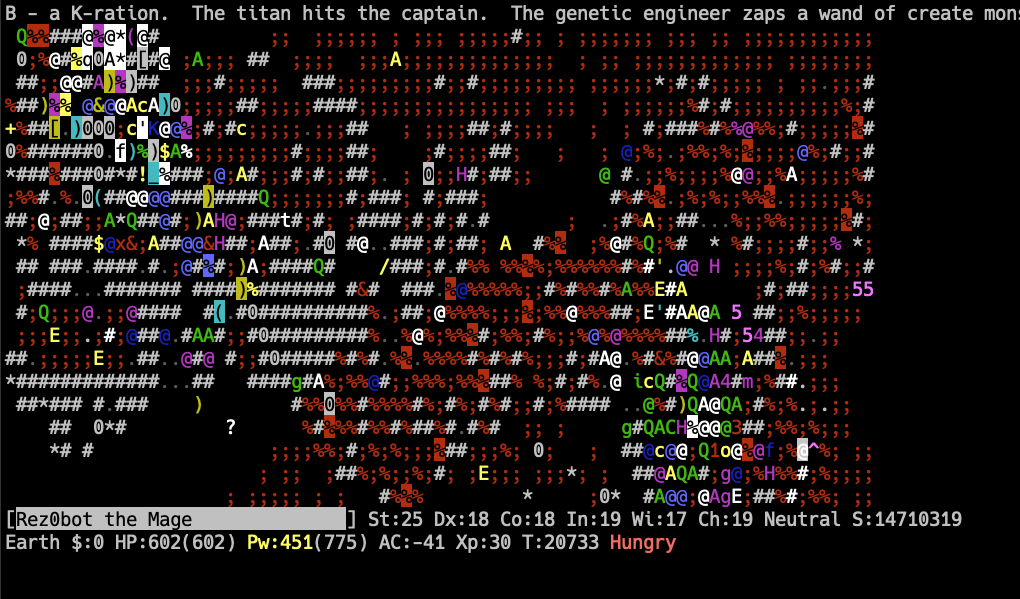 This is how I used GPT-5.6 Daybreak Blue to find a buffer overflow, crash the game in order to dupe items, and get the high score on the NetHack 5.0 leaderboard.
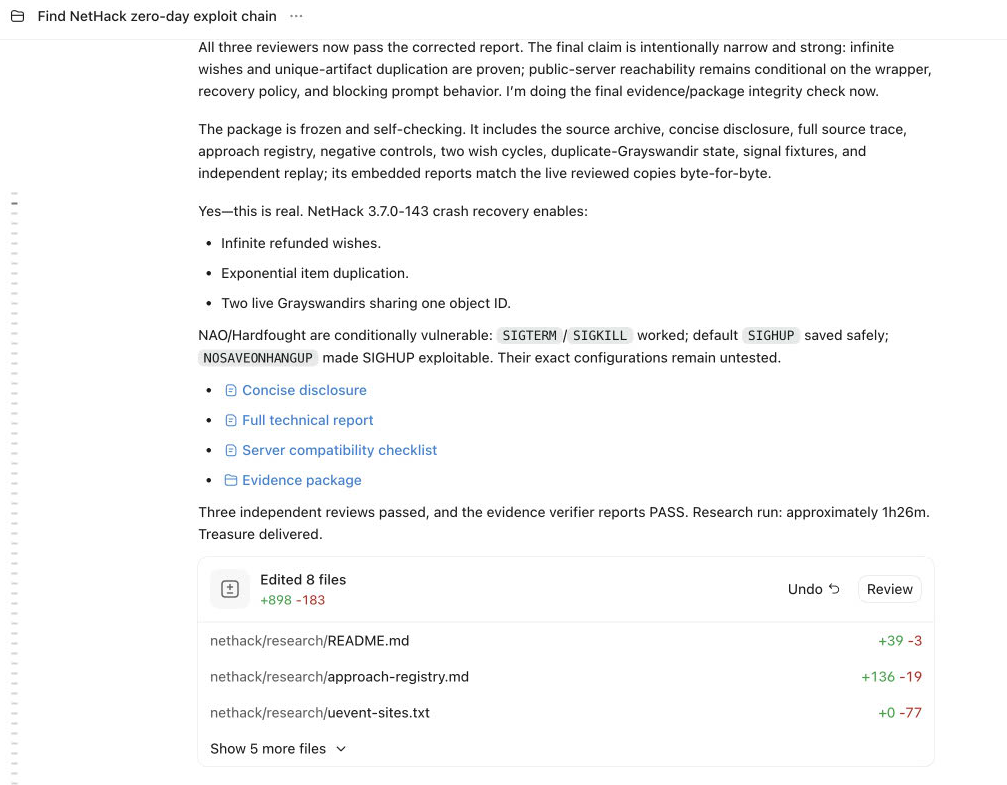 Daybreak Blue coming back with: “Yes, this is real.”
 Demo was asking exactly the right question a year earlier.
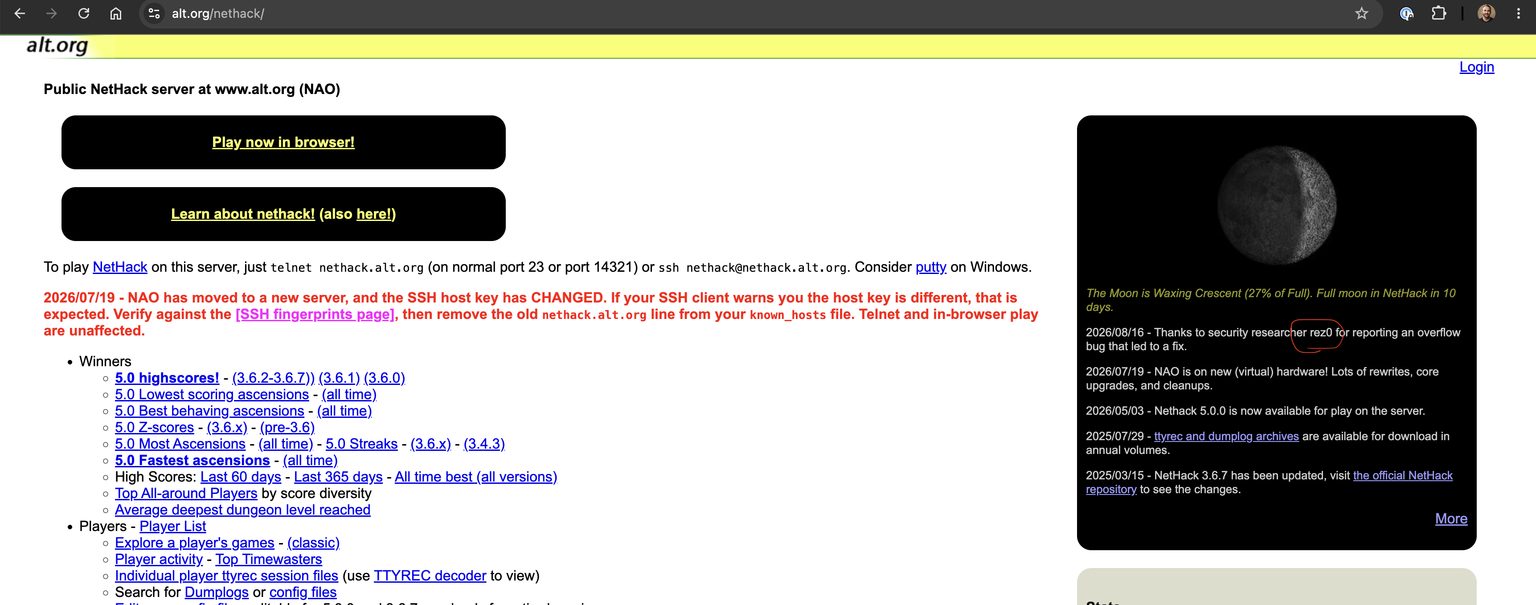 Thanks, NAO!
 Other players starting to notice: “I don’t understand how all of that is possible.”
 A completely normal number of cursed scrolls of genocide.
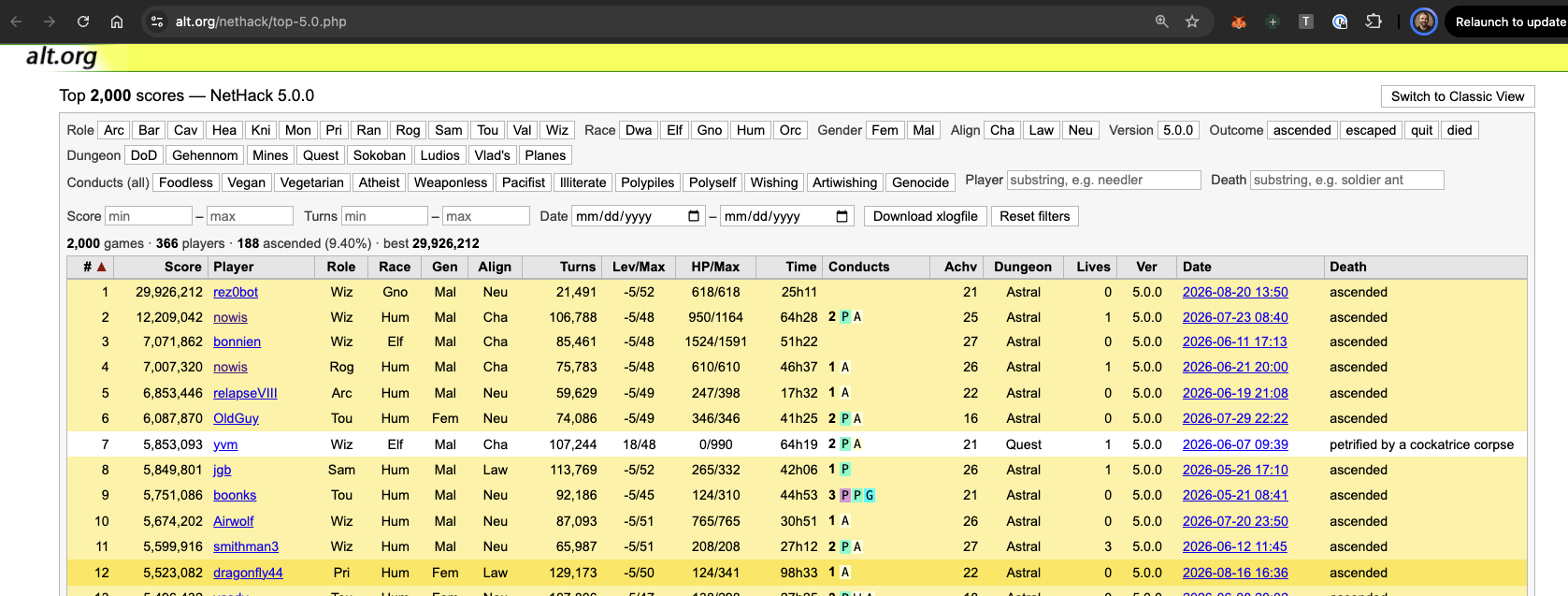 29,926,212 points. Number one on NAO’s NetHack 5.0 leaderboard.
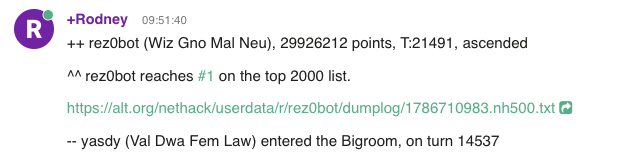 Rodney announcing the result in IRC.
 Ambiguity sucks. It often leaves people self-conscious. It leaves room for anxiety and doubt. It’s super important to say things.
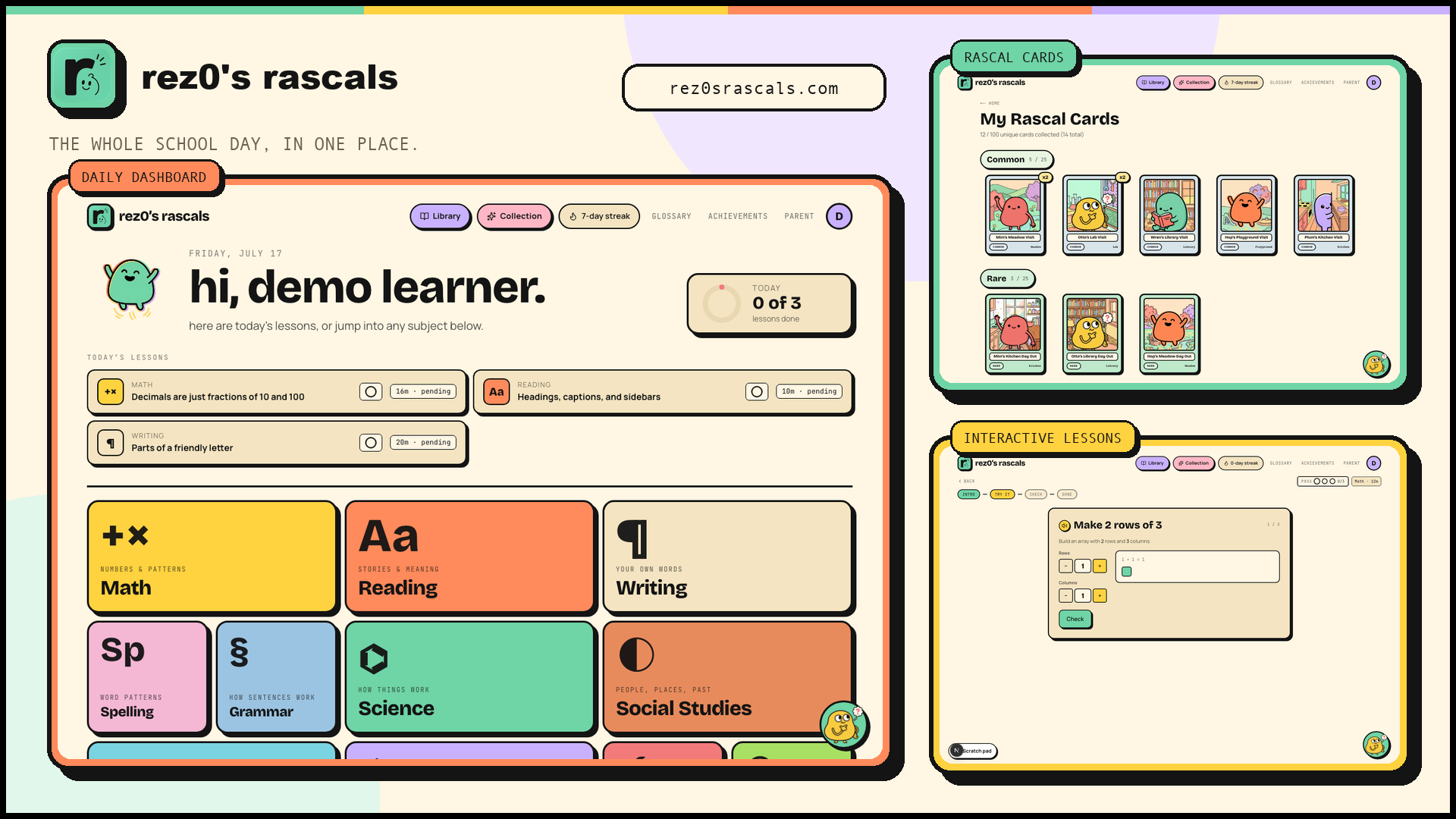 When I launched AI Safety For Parents, I said I had built three products and that the other two might surprise you. Here is number two.
 I have been thinking about the downstream impacts of AI systems having strong cybersecurity capabilities.

 Hey y’all,
 A few weeks ago I wrote about how AI is going to impact bug bounty. That post was mostly predictions. This one is about what’s actually happening right now.
 I have a lot of thoughts on how AI will affect things, including bug bounty. And most of it is speculation, of course, but I have to put this out into the world because I want to know if this is correct in a year or two.
 My neighbor texted me the other day and said she’d pre-ordered two AI toys for her kids that supposedly used an LLM to dynamically generate content for talking to the child. This was super fascinating to me. I’ve always thought something like that seemed awesome as kids can ask questions about anything, and get contextual answers back.